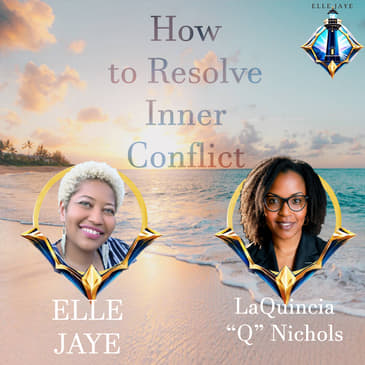
In this episode of Evolving With Elle, Elle Jaye sits down with conflict and communication coach LaQuencia Nichols to explore internal conflict, trust, boundaries, and personal evolution.
Together, they discuss how past experiences can leave us guarded, why growth can change our relationships, and what it takes to let go of old identities and expectations. Laquencia also shares her journey from corporate success to entrepreneurship and the courage it took to choose a path that felt more aligned with who she had become.
The tension between who you were taught to be, who you are now, and who you’re becoming—and the courage required to choose what feels aligned.
The Shift Beneath the Words:
- Trust, Guardedness & Connection
- Communicating Healthy Boundaries
- Growth Can Change Your Relationships
- Navigating Internal Conflict & Change
- Leaving the Comfort Zone & Choosing Yourself
About the LaQuincia “Q” Nichols:
LaQuincia “Q” Nichols is a Conflict Resolution and Communication Strategist, speaker, and founder of Experience Coaching. She equips ambitious women, leaders, entrepreneurs, and families to navigate the conversations they have been avoiding—so that they can protect revenue, strengthen relationships, uphold their standards, and move forward with self-respect. Through her S.P.A.R.K. framework, Q brings practical language and grounded strategy to real-life moments of tension, from client and team conversations to family dynamics. Her work proves that clear communication is not just a soft skill—it is a pathway to stronger leadership, healthier relationships, and sustainable growth
Connect with LaQuencia:
Website: https://experience-coaching.com/
LinkedIn: https://www.linkedin.com/in/laquincia-nichols-741833b/
Instagram: https://www.instagram.com/quincie_experience_coaching/
Facebook: https://www.facebook.com/profile.php?id=61574731391974
Youtube: https://www.youtube.com/@experience-coaching
LaQuencia’s gift for you:
Book a complimentary 15-minute Conflict Clarity Chat and a link to download the Family Conversation Starter Kit:
Free Call: https://connect.experience-coaching.com/widget/bookings/conflict-clarity-chat
Free Guide: https://experience-coaching.com/family-conversation-starter-kit
Visit our GIFT VAULT - updated weekly for more gifts from other guests on this podcast and other podcasts in our network.
https://network.inspiredspeakernetwork.com/vault
About the Host:
Elle Jaye is a professional woman, speaker, facilitator, entrepreneur, and host of “Evolving with Elle: When Capable Women Carry Too Much”. Drawing from lived transformation, professional leadership, entrepreneurship, and continued study, she partners with capable, heart-centered women who appear successful yet feel overwhelmed, second-guess themselves, or are tired of living by expectations they did not choose. As a Holistic Alignment Strategist, Elle uses honest reflection, elevating conversations, and her mirror, map, and method approach to support women in reclaiming their inner authority, honoring their capacity, and creating lives rooted in their values. She believes evolution is personal, but it does not have to be solitary.
Connect with Elle:
Website: https://mailchi.mp/3ae59b526c7c/ellejaye
Instagram: www.instagram.com/ellejayesllc
Facebook: www.facebook.com/ElleJayesllc
Youtube: https://www.youtube.com/@THRIVEAfter
The Evolving With Elle Podcast is proud to be on the Inspired Speaker Network.
⭐⭐⭐⭐⭐ Don’t forget to follow, rate & review. It helps us reach more people who want to create positive change in the world, like you.
Check out More Shows from the Network at https://inspiredspeakernetwork.com
Visit our GIFT VAULT - updated weekly for more gifts from other guests on this podcast and other podcasts in our network.
https://network.inspiredspeakernetwork.com/vault
Thanks for listening!
Thanks so much for listening to our podcast! If you enjoyed this episode and think that others could benefit from listening, please share it using the social media buttons on this page. Do you have some feedback or questions about this episode? Leave a comment!
Subscribe to the podcast
If you would like to get automatic updates of new podcast episodes, you can subscribe to the podcast on our Network, Apple Podcasts, YouTube, or your favorite podcast app.
Leave us an Apple Podcasts review
Ratings and reviews from our listeners are extremely valuable to us and greatly appreciated. All the main search engines reference Apple metrics so ranking higher on Apple Podcasts will expose our show to more awesome listeners like you. If you have a minute, please leave an honest review on Apple Podcasts.
Welcome to Evolving with Elle, where a capable woman recognizes what she's managing, understands
Speaker:the responsibilities that she's carrying, and chooses self-honoring over self-abandonment,
Speaker:and decides to continue, change, or release.
Speaker:I am Elle. I bring the mirror, the map, and the message. You choose how you show up in a way that honors your capacity.
Speaker:So let's lean in, learn, and evolve together.
Speaker:Hey, LJ here with LaQuincia Nichols. I am so glad that I got her on here because she runs a
Speaker:Conflict Clarity Lab, and you guys know the other day I was sharing with you about being able to
Speaker:talk about what I'm proud of, but at the same time feeling some kind of way because I was told to
Speaker:always be humble, not be proud, not be braggadocious, but that created that internal conflict.
Speaker:And in life, I was just going through, okay, I made this step, I made that step, made it to management.
Speaker:I'm just chasing results based on the role that I'm in. So the role that I was talking about was
Speaker:the employee role, and I was doing the things. I did that, right? I did entry level to manager
Speaker:in four years. Yes, I did that, but I didn't take the time to celebrate because there were other
Speaker:role responsibilities hanging around. I wasn't just an employee. I was a mother, I was a wife,
Speaker:a friend, a sister, a daughter, all of those things, and they were just kind of merged into one.
Speaker:But as we reflected on what we get to celebrate, now it's time to talk about the life disruptions
Speaker:that kind of flow along with it all. And that is why LaQuincia is here. So Q, I'm going to give
Speaker:you the floor. Share with us what you want us to know about yourself and whatever you are comfortable
Speaker:sharing about your life journey and also share what you are most proud of.
Speaker:Absolutely. So I love that, and I think I honor and respect the fact that you are willing to say
Speaker:I never stopped to take a moment and really celebrate myself. And what's exciting about that,
Speaker:and I think also sometimes what's hard about that is a lot of us were taught to not celebrate
Speaker:because of being humble. So there's so many things that we didn't get to revel in the accomplishment
Speaker:of because it was just set up on us as expectation. Well, that's what you're expected to do.
Speaker:I'm not going to reward you for the things that you should be doing, right? But in that, we don't
Speaker:learn how to also receive those celebrations of ourselves. We start to put ourselves in a space of,
Speaker:oh, well, here's the thing. I'm a better gift giver than gift receiver. I want to be good at
Speaker:both. I want to receive nice gifts, and I want to give out nice gifts, right? Yes. So I'll back up
Speaker:and I'll start to share with the audience. So yes, I'm LaQuincia Nichols. I'm the owner of Experience
Speaker:Coaching, and I really work at the intersection of conflict, communication, relationships,
Speaker:and also where that may impact your revenue if you're a business owner. And a lot of the work
Speaker:that I do was informed by, I would say, the generation and the location in which I grew up.
Speaker:I am a girl from Southern California. I grew up seeing conflict handled very poorly,
Speaker:but also very successfully. And where I saw where conflict was not handled well, you know,
Speaker:there could be things, either traumatic loss, broken relationships, but also lost opportunities.
Speaker:And when I moved from being sort of a girl in the neighborhood that I grew up into,
Speaker:and to the corporate woman that I am, right, the corporate leader that I was,
Speaker:I also saw more and more women, especially, who would be leading wonderful organizations,
Speaker:maybe leading sales teams, whatever that may be. And they were wonderful advocates for everyone else
Speaker:around them. But when it came time to speak up for what they needed, right, whether it would be
Speaker:the strategy that maybe they want to try and deploy, maybe it was a promotion that they should
Speaker:have raised their hand for, but they didn't. Or, right, just saying, you know what, this isn't
Speaker:working for me, and I'm going to go do something that feels more aligned with where I'm in my life
Speaker:now. I wanted to provide a structure, you can call it a framework, just a way for women to
Speaker:lean into that conversation prepared, right, and with the clarity first of what it is that you're
Speaker:looking for, and then how do you really back into that. And so I do that through my Conflict
Speaker:Clarity Lab that you talked about, I do that through my SPARK framework, but I do it through
Speaker:conversations like we're about to have, right, just pushing the envelope a tad bit, asking that
Speaker:next level question, just so we can open up into transparent conversation that has an end goal of
Speaker:closeness, richness, more robustness, but also trust. And I think that's missing from a lot of
Speaker:our relationships. Oh, yes, it is. I have so many questions I want to ask you. And so let's start
Speaker:with that trust question that you were sharing. As people, women who have been through some
Speaker:challenging times, things that disrupt our lives, or maybe we don't even
Speaker:know what our lives are because we're so busy sacrificing for everybody else. You haven't
Speaker:been able to step back and observe because you're so busy in it. Yes. And because of that,
Speaker:what I remember being guarded. Yeah, I had a wall up, couldn't trust anybody suspicious of everything
Speaker:around me. And I not only that, I have seen other women that I've worked with, that are so guarded,
Speaker:you ask them a question from plain curiosity, and they are raring to bite your head off,
Speaker:or say, Oh, what you trying to sell me? What's in this for you? And, and there's so much defensiveness
Speaker:rather than discernment. Yeah. So
Speaker:in your work in supporting women with that kind of conflict and getting clear with themselves,
Speaker:do you support them in helping to get that guard down? The guard has to come down. And I think it,
Speaker:we can't move to true connection. You don't have to take off all of your guards, right? Because
Speaker:some of those are there to truly protect you. But when your guards are prohibiting you from
Speaker:developing rich relationships with people, then I would say that's probably something to think
Speaker:about because oftentimes we talk about, well, this is my boundary. If someone crosses it, then
Speaker:I'm done with them. Well, oftentimes, and what I see a lot in the work that I do is that we're
Speaker:penalizing people for crossing a boundary that we never verbally stated to them, right? We expect
Speaker:for them to know. And to me, that's hard because you're not setting that person up to be successful
Speaker:in the relationship with you, right? Oftentimes when you think about when you start doing
Speaker:something new, or maybe you take on a new job or a new role, you'll learn. So you'll be advised,
Speaker:what are the expectations? What are the responsibilities? What are the things that
Speaker:you can or you cannot do? We don't move as clearly in relationships or friendships in the same way.
Speaker:So what I say is if you know that you have some hard lines, right? A boundary that may be out of
Speaker:the general norm for most people, that's something that's incumbent upon you to share with those
Speaker:people so they know. But when you talk about letting down the guard, I think there's a lot
Speaker:of intersection in that question, right? Because you have that question for me, I sit here as a
Speaker:woman, right? But on top of that, a black woman, right? And so my gauge and my relationship with
Speaker:trust may be very different than women of a different background, right? And so with that,
Speaker:it's a first knowing that with most women, it's usually competitive, right? So how do we first
Speaker:stop and say, I'm not wanting to compete with you. What I want to be able to do is understand where
Speaker:you're coming from. Through that, I have to get to know you. That comes through answering questions.
Speaker:But if you come from a place of asking questions, asking why, asking that third question was seen
Speaker:as disrespect or you're judging me or whatever that may be, then you're already coming into this
Speaker:with a sense of you don't want to connect. And if you don't want to connect, that's one thing.
Speaker:But I think that really leans into a more of a lonely existence, whether it's professional or
Speaker:personal, because whatever you do, you need a network of people around you who are willing
Speaker:to speak up for you when you are in or you're not in those rooms. But also people love to be
Speaker:engaged and also in relationships with people who they trust. I build trust over time, getting to
Speaker:know you, watching how you show up, what works for you and what doesn't. So for me, the thing with
Speaker:trust is you can only do so much. You have to first be willing to say, are there some misalignments
Speaker:that I may have with that person? And if not, then it's just about getting to know them. Now,
Speaker:do we spend the time to get to know people? I don't think we do that as much as we used to.
Speaker:Right. I so agree. I so agree with that. It's not an all or nothing. It's a both and.
Speaker:With the both and, it's not saying to just open yourself up willy nilly.
Speaker:Yeah, it is. But it's also not be so closed off and hard that no one can get in.
Speaker:Absolutely. I mean, have you ever tried having a conversation with someone and all you get is
Speaker:yes and no answer? They don't expound on anything. They don't have any sort of deep
Speaker:point of view. And sometimes, you know, depending on their background,
Speaker:someone may have taken that from them, right. And tell them that their voice wasn't of value.
Speaker:And so they may have that conflict of how much do I share or I've tried to share different areas
Speaker:before and it hasn't been valued or it's been thrown back in my face. Or, you know, maybe they
Speaker:just don't have the language, right. Sometimes we are dealing with deeper issues in regards to
Speaker:sharing. Very true. And specifically on those short answers, there's definite wounds there.
Speaker:Well, let me, let me not say definite. There's probably some unexpressed or undealt with wounds.
Speaker:And the reason I said probably, or definitely was I was thinking myself, you know,
Speaker:for me, so it shouldn't happen for everybody else. Right. That's the thing that we don't want to do.
Speaker:So probably 99% of the time, it may be from, right. And I can laugh about it and smile about
Speaker:it now because I was able to look at myself in the mirror. Yeah. That was not an easy thing to do.
Speaker:And as we sit here and we talk, the thing I always let everyone know that as you're here
Speaker:on Evolving With Elle, I bring the mirror, the map and the method, and my guests are doing the same
Speaker:thing. Q has brought up some wonderful points for us to reflect on when it comes to trust,
Speaker:being guarded. And are we so guarded that we don't let anything in? And when we don't let anything
Speaker:in, guess who else is stuck? The person on the inside of that gate. Because you're not letting
Speaker:it out. Nope. Right. Sometimes there are different guards or protections that we put on when we were
Speaker:children or teenagers or young adults that you needed at that time. Right. But until you sit
Speaker:back and then intentionally take that guard off and say, you know what, I'm going to open up this
Speaker:area of my life. I'm going to share a little bit more. I think about even, you know, oftentimes
Speaker:there's different sort of coping mechanisms we could have of why we want to stay guarded or say
Speaker:we have low trust. Right. And I think even in terms of social media, sometimes what I've learned as
Speaker:I've been able to mature through this, because maturity and age are not always the same.
Speaker:They are not. But as I've been able to mature through this and as I became more consistent
Speaker:with who I am, how I show up, the messaging that is true to me, well, there was less conflict
Speaker:with me and who I presented on social media. It's the same person. Right. But if I'm so busy trying
Speaker:to present someone else because I haven't done the deeper work to say, you know what, I am someone who
Speaker:is a bit bubbly muscle, someone who likes to go quiet and silent at times. There are all these
Speaker:parts of me that make me who I am. And that's OK. But it has more to less to do with the other
Speaker:person and more to do with me. Oftentimes when we're not willing to share about who we are,
Speaker:it's because we are still dealing with it. Right. And we don't have the answer. We don't have the
Speaker:solution. So we don't want anyone to question because also we may not be ready to make that
Speaker:decision. And one of the best things I ever heard someone share to me when I asked them a question
Speaker:and they said, I'm not ready to say those words out loud yet because once I say them out loud,
Speaker:I have to own it and I don't want to have to own it because then I got to make a decision.
Speaker:And then that decision may require me to do something different. Right.
Speaker:Such true words have not been spoken. And what I also want to introduce at this time,
Speaker:Pew, is. As we're talking about this inner work, there are different avenues in which that inner
Speaker:work can be done, because I know I'm not a mental health professional, are you? Me neither. Go talk
Speaker:to the people who are licensed to do that. Yes, please. And. With those licensed mental health
Speaker:professionals, they help you do that deep work, touch and express the things that you
Speaker:are not ready to yet. Right. They help you develop that plan in order to do it. And I,
Speaker:I know there's a lot of people who are like, oh, going to mental health professionals,
Speaker:that really doesn't work. That's their opinion. Yeah. And my opinion and my experience is.
Speaker:It has been beneficial to me because. When some big life disruptions happened,
Speaker:there was a lot that happened all at once. And it was too much for me to share with a friend
Speaker:because the friend did not have the capacity to hold it because guess what? They were going through
Speaker:something too. Yeah. Well, guess what? Also, I think with that, it's not their responsibility
Speaker:to hold that for them for you. Oh, it's not. It's a little bit unfair for us to think that
Speaker:we should be able to put all of this lift and shift that to someone else on top of everything
Speaker:that they're managing through as well. Right. And that is why investing in mental health
Speaker:professionals. Those are the people who said I signed up to help you with your load. Yes.
Speaker:And I think, you know, one of my my closest, dearest friends is a licensed therapist.
Speaker:And we she and I, you know, when I moved into coaching and consulting work, we had a lot of
Speaker:conversations just about the differences. And what was great is we really figured out a way
Speaker:to be having a true sort of referral system for people who may have come to me. Right. And maybe
Speaker:they need help that is beyond my capability, which is very easy for me to be able to tell
Speaker:because I what I love about, you know, talk therapy is it sort of takes you in the past and it helps
Speaker:you kind of figure out a lot of the reasons why you move forward. But in terms of coaching and
Speaker:the way I'm working with clients, it's about understanding, like, how do we make quick work
Speaker:right, quick action, quick steps and move forward and move forward. Right. And that requires a lot
Speaker:of and I say a lot of playfulness. Right. Because you have to be willing to go out and try and come
Speaker:back and see, did it work right? And with that, then it allows for us to be able to adjust and
Speaker:sort of a dance that we do back and forth of what feels right for you. Where do we need to pull back?
Speaker:But the people who are doing them, the mental health work in an official licensed capacity
Speaker:to me, they are people I love to be in partnership with. I don't see any reason for us to sort of
Speaker:have any conflict between the two of we both sort of work in our own swim lanes.
Speaker:I agree with you, Q, very much so, because the difference between coaching or a consultant or
Speaker:a strategist is we are supporting the woman who is receiving that healing from the mental health
Speaker:professional regarding what has been in the past. And we're like, OK, well, you're here right now.
Speaker:Let's help you move forward. Let's support you as you make those decisions and play and partner
Speaker:with you as you say, hey, this is what I expect to happen going forward. And then we'll see. Right.
Speaker:And then be able to learn and say, oh, no, that didn't work. Great. What did you learn? Let's
Speaker:lean into that. Yes, it's it's going to be uncomfortable. So as you are coaching these
Speaker:women through like their internal conflict. How do you support them in knowing like, hey.
Speaker:This is where the conflict is coming from. It's OK to have this internal conflict,
Speaker:be aware of it, how to move it forward. I'm saying so many things here. Yeah. You pick
Speaker:where you want. I think it's it's it's multilayered. Right. I think that's why
Speaker:there's so much to say there, because there is the woman who I am now. Right. Versus the person
Speaker:I was probably raised to be and also the person that I want to be, you know, maybe 10 or 15 years
Speaker:from now and to a certain point, all of those those different iterations of myself will be
Speaker:in conflict because I will need to shed certain parts or certain certain skins of myself to be
Speaker:able to put on the new skin I need within this stage of my life. And that can be very hard because
Speaker:as you're going through that shedding process, which it truly, truly is a lot of people talking
Speaker:about healing. Right. And they make it look really fun on social media. But when you're doing the
Speaker:real healing work, it's messy. It is uncomfortable. It can be a little dark at times. It can feel very
Speaker:isolating. The people around you won't really sometimes understand how to even respond to you
Speaker:anymore because the conversations and the interests are that you maybe had before.
Speaker:Those aren't the things that light you up anymore. So you almost have to reintroduce yourself to
Speaker:people all the time. And even in that right internally, you'll start to think about, do I
Speaker:really want to reintroduce myself to them? Because if they are still the person that they were,
Speaker:the new person who I am, the evolved person who I am, we may not be on the same frequency anymore.
Speaker:We may not have the same things to talk about. And for some, it is easier for them to stay in this
Speaker:vacillating back and forth of I'm kind of in, I'm kind of out because they don't want to lose
Speaker:everything that they've been so connected with. But to do that, to be able to say, okay, that's
Speaker:who I was and that's got me ready for this step here. Now, as I'm in here and I'm doing this and
Speaker:I'm probably excelling, but at that same time, I am preparing myself for the shedding of this skin
Speaker:for the woman that I need to become next. And even the people who are with me right now,
Speaker:there are certain people that I may have to, again, shed them too, right? Because if they're
Speaker:not willing to continue to be just as ambitious as I may be in the better development, right?
Speaker:So whether it is personal or business, but overall development of who I am as a being,
Speaker:that I'm not going to slow down my evolution process for the comfort of who they want me to be.
Speaker:Because oftentimes as you're making those evolutions, it's a mirror, right? Back to
Speaker:your three Ms, it's a mirror of some of the choices or the actions they're deciding not to do,
Speaker:staying in their excuses, staying in that disappointment, staying in that judgment,
Speaker:rather than just saying, you know what? It didn't work out, but I'm not going to stop
Speaker:me from trying again. I'm just going to try a different way.
Speaker:Mm hmm. Yes. And I remember hearing Michelle Obama in an interview say that she and Barack
Speaker:were trying to pull people up the mountain with them. And then they had to realize it's like,
Speaker:okay, I can't pull you up. You either come or you stay. That's my understanding of what I
Speaker:understand of what she said. And that lines up with what you're, you are saying. And it is a
Speaker:challenge to separate in relationship to someone who was pivotal at a particular point in your life
Speaker:because they served a purpose. Absolutely. That relationship was real and it was connected.
Speaker:And that can be a huge challenge, but with discernment,
Speaker:you get to say and be honest with yourself. And here's also the wonderful thing that I've
Speaker:experienced. Some people will self separate from you and you don't even have to make the decision
Speaker:and you can just say, okay, I don't have to pull anymore. I'm a little lighter.
Speaker:Well, cause here's the thing with that too, Elle, is like when you're thinking about,
Speaker:and that's such a great visual, right? I'm trying to pull people up the mountain.
Speaker:Number one, maybe they're not ready, right? Because they still have a lot of shedding that
Speaker:they have to do. Do they have the skills that are required, right? That is for that next level.
Speaker:Are they ready for that? Now to a certain level, I absolutely believe readiness is,
Speaker:it's a decision. It's a choice. It's not as much as a feeling as people like to lean on.
Speaker:You decide, right? I'm going to do this and I'm going to figure out the skills I need to get that
Speaker:thing done. But on the other hand, the self selection is also a marvelous thing to watch
Speaker:as well because it's the little things, right? You see maybe less engagement from them on your
Speaker:social media because the posts that you're posting no longer aligned with the things
Speaker:they're interested in. When they call you, right? If they call you or in my case, the phone,
Speaker:it starts to dry up because my conversations are different. The way I want to spend my time
Speaker:is maybe a little bit different. I value different types of conversations.
Speaker:So as I start to do that, my circle starts to change, right? And I liken it to people when
Speaker:people get really into health and fitness. Well, guess what? All of their friends start becoming
Speaker:gym people, right? Because that's what they like to do with each other.
Speaker:And they want to figure out the next exciting protein powder and let's go to this new place,
Speaker:right? So it's about, we just have new but different interests. And I'm happy to introduce
Speaker:you into my new interest, but I'm not going to force my new interests on you. That's not fair
Speaker:to them. Correct. It's not fair to them, nor is it fair to you. And with what I believe we both
Speaker:share with the people that we want to support is you matter. You also matter. It is really,
Speaker:truly a both and. The relationships that you have based on being in the various roles,
Speaker:employee, mother, spouse, parent, all of those roles have a relationship attached to them,
Speaker:right? And there could totally be conflict between you and the person on the other side
Speaker:of that role that you're serving in. But you also have that conflict within yourself about,
Speaker:hey, how do I approach this person? What is it that I say? And Q, you mentioned earlier about
Speaker:a person, a woman deciding, hey, I don't need to be here anymore. So in your professional career,
Speaker:you weren't always a coach. So how did you step out of your corporate career into coaching? What
Speaker:was that internal dialogue like for you? And did you have some internal conflict with that?
Speaker:I had a lot of internal conflict because for all intents and purposes, I looked perfect on paper,
Speaker:right? Like I had the job that paid me a comfortable six figures, house, married,
Speaker:dog, like outside of the true picket fence, I really had the things going. And right around
Speaker:when I turned, I would say probably my mid forties, I realized that the person who walked
Speaker:into the company 15 years earlier was not the same woman who was sitting in the seat. I had
Speaker:made a lot of evolution. I had wanted different life experiences. And I knew that the more I
Speaker:continue to grow in my career, right? The more it would require of me, but I actually wanted a
Speaker:little bit less of that and more of my own flexibility. The great part of what I was doing,
Speaker:and because I was leading leaders and doing already a lot of coaching and training and
Speaker:development and leadership talks, it was a, it was an easy lift and shift in terms of the content
Speaker:of what I was doing. What I had to go in my own inner critic and my own conflict was I was a
Speaker:corporate girl. I knew nothing about the entrepreneurial lifestyle. It was often said
Speaker:in my house is, you know, you go and you get that good job and you do it for 20 years. And that's
Speaker:just what you do. So for me, a lot of it was helping people understand that I was not having
Speaker:a midlife crisis, right? It was, it was not be like having like some sort of perimenopause fit.
Speaker:It was actually a strategic decision because I was at the crossroads in my career. And guess what
Speaker:they did? They gave me a coach. And as I got to continue to sit and talk with that coach and
Speaker:someone who was very opposite of me, a white male coach. And I remember he was like covered with
Speaker:tattoos and also usually coached men who were prioritizing a sober living lifestyle.
Speaker:Me and this guy really had no reason to be connected outside of there was just something.
Speaker:When I saw him, I said, I think that's the person for me. And so as he and I continued to talk,
Speaker:he said, I don't think that you want to do this type of job anymore. You want to do something
Speaker:different. You just don't know how to say it. And I said, yeah. Okay. And so as I continue to
Speaker:think about that and I started listening to myself and the way I was talking to other people
Speaker:about the work that I was doing and some of the limiting beliefs that I had that were coming from
Speaker:that role. And I said, oh, wow. I think I'm talking to myself. Right. Yes. And as I started
Speaker:to realize that I said, okay, let's start making some, some decisions. Right. And so then, you know,
Speaker:first you sort of have that conversation with yourself. Like, am I, do I want to have this
Speaker:conversation with my spouse? Right. Then you have the conversation with your spouse. Hopefully your
Speaker:spouse is on board. My spouse was on board. Right. So, right. Cause that also makes it easier
Speaker:when you have a, a system of support. Now also I would say that last S and my system of support
Speaker:was also, I got a severance. I had been with a company that I was with for a while and I had my
Speaker:own decision point. Do I take this other opportunity or do I decide to exit my role?
Speaker:And I said, you know what, this is a time for me to bet on me and I'm going to exit the role.
Speaker:And that was scary as heck, but I knew that I could figure it out. I was willing to let myself
Speaker:go back in the seat of being a learner, no longer the expert. And that is where I think for me,
Speaker:just being willing to be a sponge and absorb and learn, right. And be okay with it, not working
Speaker:out right. It being okay with, I may not be invited to, you know, the happy hours of all
Speaker:the things that, you know, they're doing at the company level and everything that I would normally
Speaker:be associated with that, having to let that go to embrace something new. And I actually took like,
Speaker:God, maybe six to eight months. I didn't talk to anyone at my previous company because I felt like
Speaker:I had to like create true separation. So I wouldn't have that. What about is in the background? What
Speaker:if I stayed? What if I stayed? I had to make what I was doing now for a focus.
Speaker:Okay. Let me reflect back. What I'm hearing you say of your journey is that you had
Speaker:some, what I like to call life disruptions, right? Yes. Because it disrupted what was familiar.
Speaker:Absolutely. What was familiar was doing this corporate job, leaving all of these people
Speaker:and you came to this crossroads and they gave you a coach and a coach that you're like,
Speaker:like, as you're talking about that coach in my mind, it's like, okay, he's tatted up. He's white.
Speaker:He's a male. You, you, that, that doesn't seem like there's alignment there. Right. Right. But
Speaker:that's the thing. We can get answers and responses from people. We wouldn't ever expect
Speaker:answers and responses from, and he was able to articulate something to you through coaching to
Speaker:say, Hey, I can see it because coaches who have been through the journey, when we turn around and,
Speaker:and we are supporting others, we can see it because we've been through it. Absolutely. And
Speaker:that's what he did for you. He held up the mirror for you and put this path in front of you,
Speaker:so to speak. And then you started walking on your own path and you got curious. I love how you said
Speaker:you stopped being the expert because let's be honest, as African-American females,
Speaker:what do we always, many of us do? We go to school, we go and prove we're supposed to be here.
Speaker:We are excellent. Yes. And I'm like, let's stop. Yeah. Let's just live our lives because our lives
Speaker:speak for themselves. The problem or the issue. I don't want to get on that soapbox too much
Speaker:is that we get challenged so much. And because we are so guarded and we haven't let the right
Speaker:people in to speak life into us, that was probably sucked out through other things where we're like,
Speaker:yeah, I'm just going to be comfortable here. I found this little journal book that said,
Speaker:nothing great comes from a comfort zone. Nothing. So we sit around and we're like,
Speaker:Oh, we're comfortable spending money, getting masters one, two, three, and getting doctorates,
Speaker:but we're not comfortable facing ourselves in the mirror, having conversations like you and I are
Speaker:having, getting curious about what else is out there, being willing to play and experiment and
Speaker:see what is possible because we've given so much of our authority, our power away.
Speaker:And you were saying earlier, it's not about blaming somebody else. It's not someone else's
Speaker:fault. And this is not victim shaming either. It really and truly is about our choice and the
Speaker:choice to do something that is difficult, do something that is disruptive, not interrupt
Speaker:because when you interrupt something, you get back to it, you disrupt and you essentially pivot,
Speaker:you shift paths and break up what's familiar. Get out of that comfort zone. Stop being on autopilot.
Speaker:Stop living by, Ooh, corporate job. Everybody said corporate job, stay in it for 20 years and retire.
Speaker:Um, where's the abundance in that? Where's the potential for growth in that? If you are in a
Speaker:position that has limits on what you can do and you are always like annual reviews,
Speaker:expectations again, those are some valid ones, but at the same time,
Speaker:it's a lot, it's a lot. And I, and I love my people who are deeply passionate about
Speaker:academia, right. And pursuing the degrees. But I also challenged sometimes and say,
Speaker:who was the degree for, unless it is truly about driving your professional career forward,
Speaker:or it's something that you need for whatever, whatever the thing may be. Right. But I do know
Speaker:some people who love to stay in that space of schooling, right. Because it's what they know,
Speaker:it's what they're comfortable with. But when you think about that, they've been in this sort of
Speaker:school space since kindergarten, preschool. Right. And so we haven't learned how to disrupt that. So I
Speaker:would, I would often ask, what if you didn't have school anymore? What would you do with that time?
Speaker:Right. And oftentimes they don't know. And sometimes it becomes scary to think about,
Speaker:right. Because you may have to then really start to execute on all the things that you've been
Speaker:going to school for and start validating, right. The time that you spent. Well, if you stay an
Speaker:eternal student, but guess what? All you have to do is continue to go to class.
Speaker:I'm ready for implementation and execution. And I do think that's one of the things
Speaker:that I love about being in the coaching, in the consulting industry, because it is about let's
Speaker:implement and let's execute. Let's move forward. Let's do the work and continue to move forward.
Speaker:Yes. And on that note, let's move forward to what you have for the audience today.
Speaker:Yeah, I'm really, really excited to share this with us to share, because I think for me,
Speaker:the same way it just took having the conversation with the right person. I like to open myself up
Speaker:to other people. And so for your audience and your listeners, I know that we're going to share
Speaker:it in the show notes is I'm offering 15 minutes for my conflict clarity call.
Speaker:It is not about a sales offer. It is truly about you bringing sort of that top line concern that
Speaker:you have to say, hey, is this something, how can I decide through this, right? Strategically,
Speaker:how should I approach this to make sure that the outcome is truly something that
Speaker:is what you're looking for compared to, are these just expectations and standards that
Speaker:other people put on you that you've just sort of been meandering through? And it's worked up until
Speaker:this point, but I think we all get to that crossroads and say, okay, I don't know if I can
Speaker:live the next 30 or 40 years, the same way I just lived these last 40. And if you know that you're
Speaker:looking to do it maybe a different way, I would love to be able just to guide you through that.
Speaker:So my 15 minute conflict clarity call free for the listeners of your show.
Speaker:Thank you so much, Q, because we know your time is valuable.
Speaker:Everyone's time is valuable.
Speaker:Yes, everyone's is, and you beat me to it. So ladies, gentlemen, gentlemen can come too, yes?
Speaker:Absolutely. Listen, I love everybody. He, she's, them, they's, however you identify,
Speaker:I absolutely respect. I want to make sure that you feel good in the decisions that you made.
Speaker:Awesome. Well, this has been a wonderful time having an evolving conversation with you
Speaker:about that internal conflict about your life journey and the curiosity,
Speaker:the learning that you are doing. And we very much appreciate your offer.
Speaker:So thank you so much for having me.
Speaker:Anytime. We are going to continue to talk, my dear.
Speaker:I love that.
Speaker:So hopefully you are willing to come back.
Speaker:Absolutely.
Speaker:At another time. So we are going to call it here. Thank you guys so much. Check out the show notes
Speaker:what Q has been offering you for that 15 minute conversation. Please take full advantage of it.
Speaker:And it will also be in our vault. So until next time.
Speaker:Y'all, I just had a great conversation with LaQuentia Nichols.
Speaker:She shared some nuggets, some gems about internal conflict and supporting people as
Speaker:they navigate different life challenges.
Speaker:So I cannot wait for you to listen to this next episode with LaQuentia and I.
Speaker:We're just sitting back having a conversation.
Speaker:Sharing our experiences. And remember, this is a time where we bring the mirror,
Speaker:the map and invite you into a method.
Speaker:So click on the link and listen to this episode.
Speaker:I believe it will serve you.